
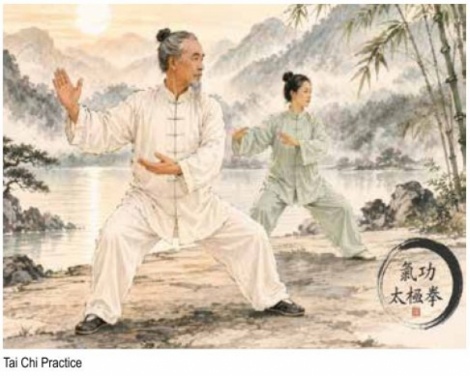
In recent years, the integration of Qìgong (%u6C23%u529F) and TaiChi (%u592A %u6975%u62F3, Taijiquan) has gained recognition as a comprehensive approach to health promotion, uniting ancient Chinese principles with modern wellness needs. Rooted in traditional Chinese culture, both disciplines emphasize the cultivation of, Qì ( ) - the vital energy that sustains life - and the harmonization of body, breath and mind.
Qìgong, historically associated with health preservation and internal cultivation, offers structured methods to regulate breathing, posture and intention. Through practices such as standing meditation and gentle repetitive movements, practitioners learn to guide Qì along the body´s energetic pathways, known as meridians. This process supports internal balance, strengthens organ function, and promotes recovery from physical and emotional stress.
TaiChi, originally developed as a martial art, complements Qìg%u014Dng by introducing dynamic movement sequences rooted in the philosophy of Yin and Yang ( ). Its slow, continuous motions train coordination, structural alignment, and the integration of intention with physical execution. The principle of "using intention, not force" is central, encouraging efficiency and reducing unnecessary muscular tension.
When combined into a unified program, Qìg%u014Dng and TaiChi provide a layered training method. Qigong establishes internal awareness and energetic sensitivity, while TaiChi refines these qualities within movement, balance, and spatial orientation. Together, they address multiple dimensions of health: physical conditioning, mental clarity, emotional regulation, and energetic vitality.
Modern research increasingly supports these traditional practices. Studies indicate improvements in cardiovascular health, balance, flexibility, and stress reduction among consistent practitioners. Additionally, the low-impact nature of both systems makes them accessible to diverse populations, including the elderly and individuals recovering from injury. Health professionals and instructors are now recognizing the value of structured integration. Programs that begin with foundational Qìg%u014Dng exercises and gradually introduce TaiChi sequences demonstrate higher retention and deeper practitioner engagement. This progression mirrors traditional training models, where internal cultivation precedes and informs external expression.
As healthcare systems seek sustainable and preventative approaches, the integration of Qìgong and TaiChi offers a time-tested framework. Beyond exercise, it represents a disciplined path toward self-regulation, resilience and long-term well-being.
Curious to try it for yourself? Join our free trial TaiChi class and experience firsthand how philosophy becomes movement, and movement becomes clarity.