
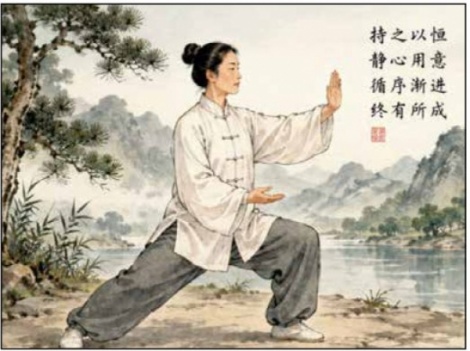
True progress in Tai Chi (%u592A%u6975%u62F3, Taijiquan) and Qìgong ( ) is rarely sudden. The arts were not designed to produce quick excitement or superficial achievement. They were developed through generations of careful observation of the body, breath, mind, and human behavior. For this reason, genuine skill develops gradually, layer by layer, through disciplined and papatient training.
One of the most important principles in practice is consistency. Many students train intensely for a short period, then stop when results are not immediately visible. Traditional training follows a different understanding. Water does not carve stone through force alone, but through persistence. Daily practice, even in small amounts, is more valuable than occasional bursts of excessive effort.
Patience is essential. In the beginning, students often focus only on external movement. They want flexibility, power, balance, or relaxation to appear quickly. However, internal development occurs beneath the surface first. Structure improves quietly. Breathing becomes more natural. Tension gradually decreases. Awareness deepens. These changes may seem subtle, but over time they transform the entire body and mind.
Students should also avoid the habit of constantly searching for “secret techniques.” Traditional instructors repeatedly emphasized fundamentals. Correct posture, alignment, stepping, breathing, and mental focus form the root of all higher skill. Without a strong foundation, advanced methods become empty imitation. A practitioner who sincerely repeats basic exercises with attention and precision often progresses further than someone who constantly changes methods.
Another important quality is perseverance. There will be periods when training feels stagnant. Some days the body is heavy, the mind distracted, or motivation weak. This is normal. The practitioner must continue calmly without frustration. Traditional training develops not only physical ability, but also character. Through repetition and endurance, the student cultivates steadiness, humility, discipline, and inner resilience.
Finally, practice should be approached with sincerity. Do not train only to collect forms or techniques. Train to refine the body, regulate the breath, calm the mind, and improve daily life. Over time, sincere effort accumulates. The results may arrive slowly, but they become deep, stable, and lasting.
Curious to try it for yourself? Join our free trial Tai Chi class and experience firsthand how philosophy becomes movement, and movement becomes clarity.