
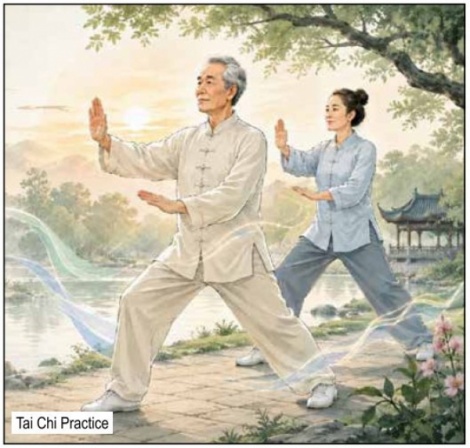
Harvard Health Publishing described Tai Chi ( , Tàijíquán) as a gentle form of exercise that can help maintain strength, flexibility, and balance- and "could be the perfect activity for the rest of your life." That statement is not simply praise for an ancient tradition. It reflects research showing that this slow, deliberate martial art can train systems of the body at the same time.
Unlike many forms of exercise that isolate one quality, the practice combines controlled weight shifting, whole-body movement, postural alignment, relaxed breathing, concentration, and changes of direction. Harvard notes that these characteristics can strengthen muscles, improve flexibility, and challenge balance without the pounding associated with higher-impact exercise. The National Center for Complementary and Integrative Health likewise reports evidence that the practice can improve balance and help reduce falls in older adults.
Fall prevention may be one of its most important lifelong benefits. A 2024 systematic review and network meta-analysis examining different forms of the art found benefits for fall prevention among older adults. Earlier research highlighted by Harvard reported striking reductions in falls among participants who practiced compared with stretching and conventional multimodal exercise groups. Government health authorities in Hong Kong, mainland China, and Taiwan also recommend the practice as a way to train balance, lower-body strength, mobility, and coordination in older adults.
Yet its value extends beyond balance. Because movements are performed slowly and attentively, practitioners must continually sense where the body is, where the weight is going, and how one movement connects to the next. This makes the exercise simultaneously physical and cognitive. Harvard has also reviewed evidence suggesting benefits for executive function, while research associates practice with improvements in mood, stress management, physical function, and quality of life.
Perhaps the strongest argument for lifelong practice is accessibility. Movements can be adapted to age, fitness level, joint limitations, and physical capacity. Training can begin gently and progress gradually.
The lesson is not that Tai Chi replaces every other form of exercise. Strength training and aerobic activity remain important. Rather, its combination of balance, coordination, mobility, strength, attention, and calm movement makes it exceptionally well suited to accompany a person through decades of changing physical ability. It is exercise that can grow older with you.
Curious to try it for yourself? Join our free trial Tai Chi class and experience firsthand how philosophy becomes movement, and movement becomes clarity.